

The Demeterian Enigma
(Weirdness at Greystone, Pt. 2)

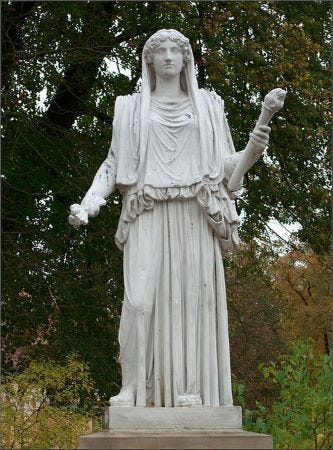
Classical statue of Demeter at Neustrelitz, Germany
Two months ago, I wrote about the mysterious statue of Demeter found on the grounds of Greystone—Samuel Untermyer’s estate in Yonkers—in July 1922. Buried in hard clay a foot below a water pipe that had been laid thirty-eight years earlier, the statue (discovered by a plumber and another laborer) had been broken into three pieces: the head, broken off at the neck; a hand, broken off at the wrist; and the body on a pedestal approximately two feet square. World-renowned sculptor and Yonkers resident Isidore Konti proclaimed the statue a Greek original, estimating that it was at least 2,000 years old. If the statue really had been in the ground for almost four decades, then it must have been deposited there during the period when former New York governor and failed presidential candidate Samuel J. Tilden owned the property.
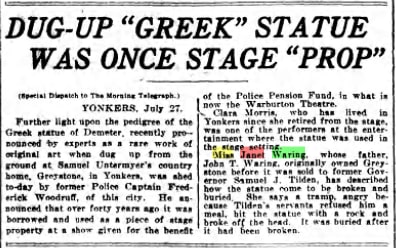
Using various search criteria, I’ve been able to find additional information on the story. The discovery of the statue was reported in the Yonkers Statesman on July 21, 1922. A week later, the New York Morning Telegraph offered an explanation for the odd circumstances of that discovery. Former Police Captain Frederick Woodruff “announced that over forty years ago (the statue) was borrowed and used as a piece of stage property at a show given for the benefit of the Police Pension Fund” in what became the Warburton Theatre (“Dug-Up ‘Greek’ Statue Was Once Stage ‘Prop,’” Morning Telegraph, July 28, 1922; story reproduced in full below). “Miss Janet Waring, whose father, John T. Waring, originally owned Greystone before it was sold to former Governor Samuel J. Tilden, has described how the statue came to be broken and buried. She says a tramp, angry because Tilden’s servants refused him a meal, hit the statue with a rock and broke off the head. It was buried after it had been broken.”
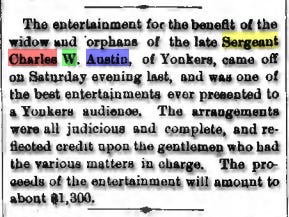
The police benefit show in question (specifically, for the family of Sergeant Charles W. Austin, who had hanged himself in December 1881) took place on January 21, 1882, as reported in the Peekskill Highland Democrat the following week:
The explanation put forth by Janet Waring and the former Captain Woodruff, however, only raises more questions. Woodruff said that the statue was “borrowed”—but from whom? Miss Waring attributed the broken head to a vagrant, but what about the broken hand? Was this same disgruntled individual allowed to take a second crack at the statue before being removed from the premises? Finally, why was the statue buried? If it truly was a Greek original, it would have been repaired; if it was a copy, it would have been hauled away as junk. In either case, it makes no sense to have buried the statue in highly compacted hard clay on the Greystone estate. The explanation printed in the newspaper simply doesn’t hold water, and I find no reference to the damaged statue prior to 1922.
But what if the statue of Demeter had been a target of iconoclasm, the deliberate destruction of religious icons and monuments? This could account for the considerable pains taken to bury the piece. In some historical instances, the monuments were buried by those who had destroyed them; in others, they were buried by those who venerated them. (The latter process is known as ritual disposal.) We don’t know what happened at Greystone in 1882, but the inadequacies of the official explanation—coupled with the various strange events known to have occurred in that section of Yonkers for many years—call for an alternative hypothesis.
It’s also worth noting that the names of the same wellbred families recur throughout the narrative: the Warings (who occupied the estate before Samuel Tilden), the Eickemeyers (Rudolf Eickemeyer Sr. manufactured the machinery used to create milliner John T. Waring’s products and, along with Tilden, he sat on the committee that organized the police benefit show; Rudolf Jr. was the photographer who so enthusiastically greeted the discovery of the Demeter statue), and Isidore Konti (a longtime resident of Yonkers and sculptor of four public statues in the city, who also designed major works of art for Samuel Untermyer at Greystone). Because judges, attorneys and physicians were allegedly involved with the cult well into the twentieth century, it stands to reason that wealthy, influential members of the community would likewise have led the cult’s earliest iteration. Were their ceremonies specifically Greek in origin, or might Demeter have served as a general symbol for fertility rites?
I have long maintained (and demonstrated) that cult activity in North Yonkers stretches at least as far back as the 1920s. This is manifestly obvious from the public record. Evidence may now be emerging to indicate that such activity began even earlier.
See also: Weirdness at Greystone (Residue of Cult Activity in North Yonkers During the Early 20th Century) https://jonathandm.substack.com/p/weirdness-at-greystone
(Those curious about the 1922-23 debate over the Demeter statue’s authenticity should visit fultonhistory.com/Fulton.html and type in “Rudolf Eickemeyer Disputes Virginia ‘Authority’ On Art”. Personally, I’m less interested in whether or not it actually originated in Ancient Greece than in its status as an object of pagan veneration. It bears repeating that the statue appears never to have been formally photographed or exhibited, and its present whereabouts is unknown. One thing is certain, however: somebody went to a great deal of trouble to bury the statue in Samuel Tilden’s day.)