

Revisiting the "Satanic Panic"
Cults, Livestock Mutilation and the Questions That the Official Narrative Doesn't Answer

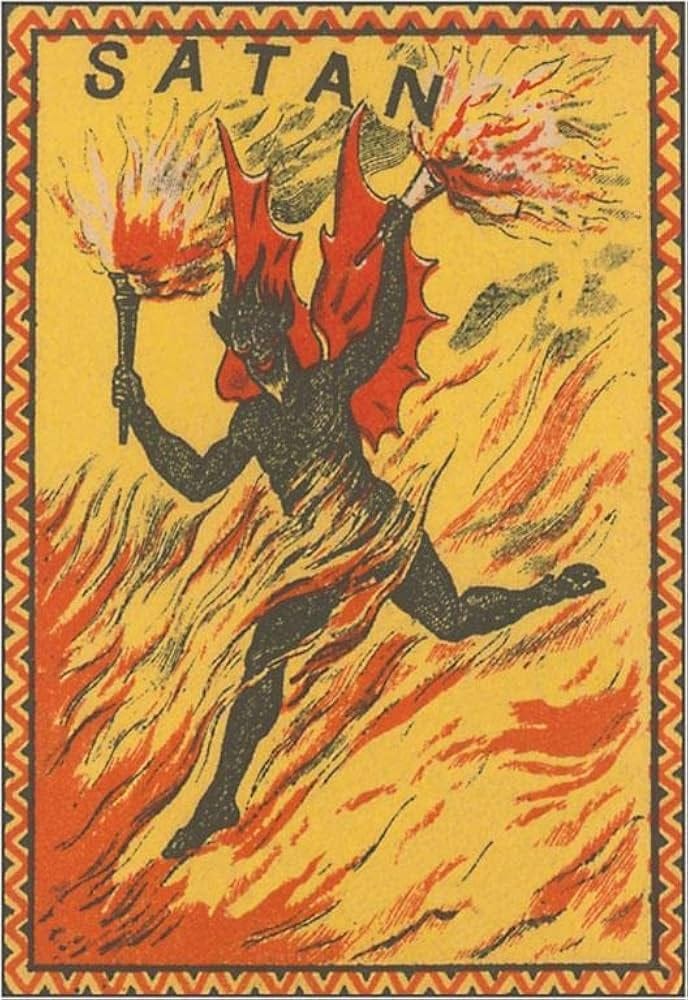
Match cover illustration - Sweden, c. 1910
Space does not permit a detailed examination of the so-called “Satanic Panic” of the 1970s and ‘80s, even if I were so inclined. The term is deliberately flippant, intended to consign any and all facts to the realm of ridicule before they can be analyzed or discussed, and admits of no exceptions. Criticisms of Maury Terry’s research routinely begin with a rhetorical question along the lines of, “Oh, didn’t he believe in some nationwide Satanic conspiracy?”
The answer is easily located in Terry’s book The Ultimate Evil, assuming that one has actually read it—so, rather than paraphrasing, I will allow the man to speak for himself: “Lower-ranking Satanists…often literally believe in the havoc they wreak, but cult leaders are likely to be motivated as much by power and greed as they are by infernal incantations. It is possible to visualize the structure the Process left in place—the network of cult contacts between various cities. And it is also possible to envision how such a structure, staffed by willing satanic slaves, could be employed for purposes that could greatly benefit a handful of leaders—both monetarily, in terms of drug distribution and child pornography, for instance—and personally, in terms of power, influence, and immense ego gratification. To those leaders, allegiance to Satan is a secondary, convenient avocation” (pg. 218 of the 1989 paperback edition).
But even if one somehow lacked access to Terry’s book (scanned copies of which are readily available online), a simple Google search would yield essentially the same result. In his 2002 inteview with John Vincent Sanders of the Fortean Times, for instance, Terry repeated the same position: “Twenty-five years ago, the satanic motif was a convenient tool for certain individuals who wanted to control groups of people for various ends; among them, child pornography and narcotics distribution” (https://web.archive.org/web/20131214074003/http://www.forteantimes.com/features/articles/234/i_am_the_son_of_sam.html). In other words, he was describing a sophisticated criminal enterprise that employed an occultic veneer to attract and maintain membership. Regardless of one’s personal estimation of Maury Terry or the temptation one might feel to make outlandish claims about him, this is what he actually said. On multiple occasions.
So let us now investigate one particular corner of the “Satanic Panic” phenomenon with an eye toward isolating the verifiable facts. On Terry’s 1997 flipper list of potential grand jury witnesses was a woman named Susan Brody. Sources in the Son of Sam case, Terry said, “report Susan’s name as ‘very familiar,’ and they state they are basically certain Susan was at sex parties in Westchester which included members of the SOS cult.” The daughter of stratospherically wealthy modern art collectors Frances and Sidney Brody, Susan was a well-known figure in the Manhattan art world. Terry noted that she “first surfaced in the notable 1975 ATF Flickenger [sic] report about segments of the US occult underground. In that report, ATF asked NYPD Intelligence about Susan, and received confirmed reports of her role in the occult underworld.”
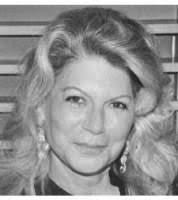
Susan Lasker Brody
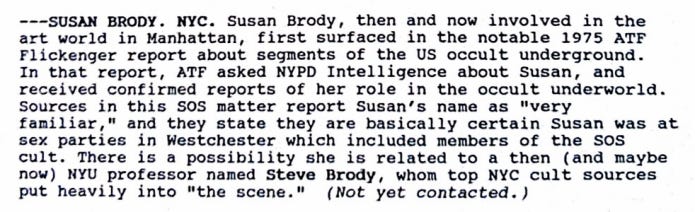
Susan Brody on Maury Terry’s flipper list of potential grand jury witnesses, 1997
Indeed, Susan Brody is named in the twelve-page report compiled by Minneapolis ATF agent Donald E. Flickinger and dated April 10, 1975. Asked by Dr. J. Allen Hynek (Director of Astronomy at Northwestern Univerity in Evanston, Illinois and former scientific advisor to Project Blue Book, the US Air Force’s study of UFOs) to conduct a private investigation of the increasingly alarming phenomenon of cattle mutilations in Minnesota, Flickinger ultimately discovered no connection between the mutilations and unidentified flying objects. He felt, however, that the mutilations were attributable to an equally unusual cause—occult activity—and the report explains why. (My thanks to George from CAVDEF for making the Flickinger Report publicly available in its entirety. It’s a fascinating read: https://imgur.com/a/flickinger-report-WV2okT8)

Susan Brody in the Flickinger Report, 1975
Flickinger’s initial source was a prison inmate, Albert Kenneth Bankston. In letters, Bankston “alleged knowledge of persons responsible for the cattle mutilations and inferred that there was an occult type movement taking place throughout the country which was using the animals as ‘sacrifices’ in their rituals and further inferred that some humans had also been killed and mutilated with more sacrifices to come” (Flickinger Report, pg. 2). Some of this knowledge, Bankston told Flickinger, had come from fellow inmate and former Minneapolis Hell’s Angel member Don Olenchuck. The two men met at Leavenworth Federal Prison in 1969, and their discussions of Olenchuck’s occult activities (including cattle mutilations) continued into 1973. At that time Bankston met Dan Dugan, a newly-arrived inmate who had known Olenchuck on the outside. Dugan, too, was involved with the occult and kept in touch with a number of penpals—including a woman named Casey McDaniel in Carbondale, Colorado. Not surprisingly, McDaniel had engaged in the same bizarre activities as Dugan and Olenchuck. (Bankston began corresponding with her, too.) Flickinger later interviewed Dugan, who recalled that he had first encountered Satan worship in Fort Worth “around 1965” and affirmed everything Bankston had said, but in greater detail.
One of the central allegations of the Flickinger Report is that members of the Fort Worth cult had traveled to Cozad, Nebraska (where they met other occultists from the local university) and inadvertently killed four teenagers camping at a nearby lake. Some of the cult members shot the teens with tranquilizer rifles containing PCP, Dugan said; the dose was excessively high and the teens died. It was decided to use parts of the victims’ bodies (including their sex organs) in the cult’s rituals. This incident was said to have occurred in the late summer of 1969, though the notation “1965?” is handwritten above the typescript as a possible alternative date. Dugan also claimed “that he had participated in the killing and mutilation of a number of small animals and cattle throughout Nebraska, Texas and Oklahoma” (Flickinger Report, pg. 4), though the Cozad incident was the only time he had ever been involved in a ritual of human sacrifice.
First, the problem with Dugan’s claim: there is no formal documentation to indicate that the Cozad attack ever took place. The incident sounds somewhat similar to the Gitchie Manitou murders, in which five teens camping in Lyon County, Iowa were viciously assaulted by three brothers looking for a little free marijuana—but that attack did not take place until November 17, 1973. It may have been the basis for Dugan’s story, but what prompted him to fabricate such a tale either partially or totally is unclear. Both Dugan and Bankston were regarded as trustworthy by prison officials, and Dallas FBI agent Jay Miller characterized Dugan as “100% reliable”. However, if misinformation were actively employed during the course of an FBI investigation, it would come as a surprise to no one.
In any event, there was sufficient cause to champion the credibility of these prisoners. As we have already seen, Susan Brody was named as a member of the cult; Dugan and Bankston maintained that she had been present at several rituals and provided financial support to the group. Even her place of employment—Park-Benet Galleries in New York—was correctly identified in the Flickinger Report, a fact confirmed in her 2022 obituary (https://www.legacy.com/us/obituaries/nytimes/name/susan-brody-obituary?id=34285794.) Under what circumstances would a career criminal like Dan Dugan have encountered Susan Brody, if not during cult rituals?
But there’s more. Carbondale, Colorado police confirmed that they were familiar with Casey McDaniel (the aforementioned penpal of Dugan and Bankston), and their files indicated her involvement with drugs and the occult. Rusty Warren, a female friend of McDaniel’s, was also alleged to be a cult member. In 1975, Warren was calling herself Eddeana Belle Iverson—and turned out to be the Eddeana Belle Wood arrested for an October 30, 1969 grave robbery in White Rock, South Dakota. Newspaper reports called the corpse-beheading incident a “prank” at the time, but a local source (Steve Johnson) said in 2025 that Wood, a nightclub dancer based in Fargo, North Dakota, “was into devil worship” and had obtained the head for use in rituals (https://www.inforum.com/news/the-vault/how-a-halloween-grave-robbery-led-investigators-to-a-dancer-two-college-students-and-a-missing-head, paywall).
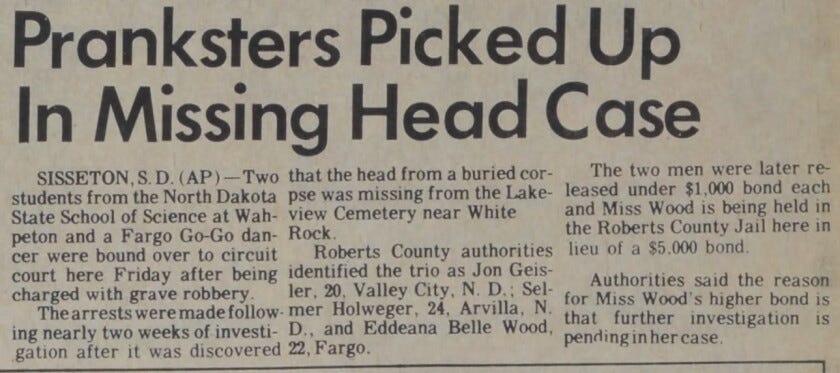
Don’t flip out, it was just a prank.
In short, the Flickinger Report contained enough accurate information about occult activity to warrant the attention of any law enforcement agency. But a retrospective report like “Portraits of the Past: Investigation into Cattle Mutilations Continues in Colorado” (Fort Morgan Times, November 4, 2018 and updated April 24, 2019; credited to the Community History Writers) fosters the impression that Donald Flickinger’s conclusions were unmitigated nonsense—flatly declaring that allegations of occult involvement in the cattle mutilation phenomenon had been debunked by the time Flickinger’s report was filed. Nowhere is an attempt made to refute any of the claims in the report; the reader is asked to accept the authors’ judgment solely on faith (https://www.fortmorgantimes.com/2018/11/04/portraits-of-the-past-investigation-into-cattle-mutilations-continues-in-colorado/). It’s a good example of how facts are set aside, or never acknowledged at all, when a verdict of “Satanic Panic” is rendered.
Incidents of grave robbery from New York State to the Dakotas…the allegation that a prominent figure in the Manhattan art community belonged to a cult active in the Western United States…the possibly more-than-tangential bearing that livestock mutilation cases in the same region may have had on the unsolved double murder of Brooklyn residents Howard Green and Carol Marron. For many of us, the parallels remain significant.
“Well,” Hardesty said, gripping the beer bottle in one hand like a hot dog, “one night back at the motel I got talking to a bunch of local sheriffs. These guys were from Kansas and Missouri and Minnesota. You know. They were talking about just this kind of setup—funny kinds of unsolved crimes. (…) Bunch of animals lying dead in a field—wham, bam, dead overnight. No cause until you look at ‘em and find—you know. Real neat wounds, like a surgeon would do. And no blood. Exsanguinated, they call that. (…) Horses, dogs, cows—we probably got the first sheep. But, Mr. Hawthorne, you brought it all back to me when you said that about the no blood. That’s right, that reminded me. You’d figure those sheep would bleed like crazy. And in Kansas City, the same thing happened just a year back before the conference, around Christmas.”
“Nonsense,” said Sears. “I’m not going to listen to any more of this rubbish.”
“Excuse me, Mr. James. It’s not nonsense. It all happened. You could look it up in the Kansas City Times. December 1973. Buncha dead cattle, no footprints, no blood—and that was on fresh snow too, just like today.” He looked across at Ricky, winked, drained his beer.
“Nobody was ever arrested?” Ricky asked.
“Never. In all of those places, they never found anybody. Just like somethin’ bad came to town, put on its show and took off again…”
Peter Straub, Ghost Story (1979)
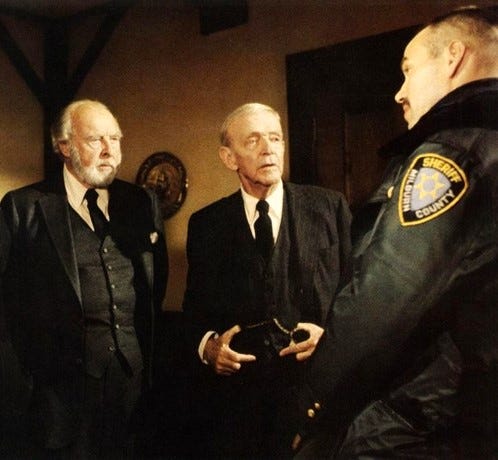
John Houseman (as Sears James), Fred Astaire (as Ricky Hawthorne) and Brad Sullivan (as Sheriff Hardesty) in 1981’s cinematic adaptation of Ghost Story